Look before naming: an observation exercise with three materials
Updated:
Remembering only “yellow” or “round” can fail as soon as a picture changes. This exercise turns a quick game guess into an observation you can explain. It is not a specimen-identification procedure: the important distinction is between what the picture shows and what remains unknown.
Prepared for the ZhongHe website · AI-assisted · No claim of pharmacist review
AI-created learning illustrations, not a guide to identifying real specimens.
Ask three different questions
Start with the outline: long, flattened, or branching? Next inspect the surface for lengthwise lines, wrinkles or a coat. Only then examine a cut face or broken end. Does the illustration actually show the inside? If it does not, record that field as unknown rather than imagining an answer.
Two independent clues are more useful than two colour words. “Slender with lengthwise ridges” describes shape and texture; “yellow and yellow-brown” still relies on colour alone. Lighting, screens and illustration choices can all affect colour.
Fennel: a small particle is not automatically a seed
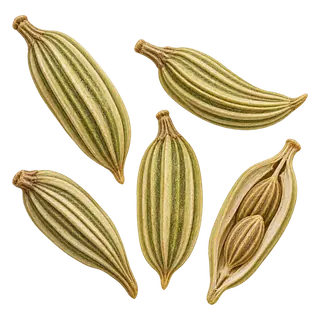
The HKBU fennel record describes the medicinal material as dried ripe fruit, with elongated fruits and longitudinal ribs. That is why the game uses Fennel fruit. The exercise connects a name to a material part; it cannot establish the identity or origin of a real sample.
Cover the notebook name and note a slender outline, slight curve and lengthwise lines. Then read the note. Did you see a feature before reading, or only expect it afterwards? An AI illustration may simplify individual ribs, so counting them in our picture is not an authentication test.
Turmeric: outside and inside are separate observations
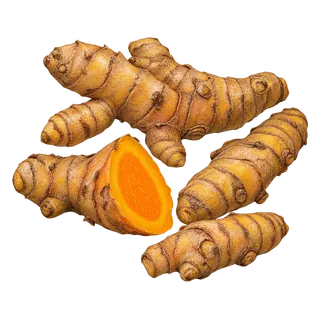
HKBU distinguishes the rhizome from the tuberous roots of the turmeric plant and describes the orange-yellow rhizome interior. Our combined Roots & rhizomes game category is a learning convenience. It does not mean every member is botanically a root, or that different parts are interchangeable.
Record branching separately from the visible cut face. If there is no clear cut, leave the interior field unanswered. Whole pieces, slices and powders expose different information. One illustration cannot establish a commercial grade, age, purity or every possible processed appearance.
Bitter apricot: similar outlines do not imply similar safety
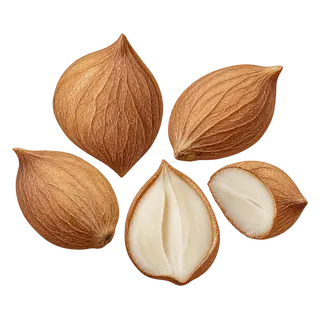
The Hong Kong Department of Health describes flattened heart-shaped kernels with a pointed end and a thin coat; commercial prepared pieces may have the coat removed. This helps explain why images under the same name can show a brown coat or an ivory surface. That reference also documents risks. We do not reproduce doses or usage instructions, or treat these kernels as casual snack nuts.
For this exercise, note the outline and whether a coat is visible. Do not taste an unknown material or sniff an unknown powder. A drawing cannot establish edibility. Real specimens and intended uses need an appropriately qualified professional and supporting labels and provenance.
Make a record that includes uncertainty
Open each of the three notebook entries and write four fields: name, two visible clues, one unanswered question, and a source to check. Close the notebook and play a quiz. After a mistake, compare your clues rather than copying the correct name repeatedly.
An example is “Turmeric; branching and an orange-yellow cut face; actual dimensions unknown; check the plant record for the part.” This is a note about an illustration, not an identification of something in your hand. If a picture conflicts with a reference, retain the question and report it instead of erasing uncertainty for a score.
Check your understanding
If a fennel illustration is larger and darker, what should you recheck?
Compare your explanation
Recheck its slender outline and lengthwise lines rather than displayed size or colour alone. Its name, material part and the safety of a real object require information beyond the picture.
These records support the corresponding naming, part and appearance statements, not institutional endorsement of the game or its images. Source photographs are not reproduced, and doses and usage instructions are not republished.